
Prometric Test Center Locations
Find Prometric test center locations near you. Search by ZIP, see what to bring, check-in steps, accessibility, and ProProctor at-home options.

Prometric Test Center Locations: Find a Center Near You
Looking for prometric test center locations nearest your ZIP code? You are not alone. More than 18,000 test takers search for Prometric locations every month, and the answer is rarely a single sentence. Prometric runs a network of roughly 8,000 test sites across more than 180 countries, with over 500 owned and partner centers inside the United States alone. Locations differ in size, hours, biometric setup, and which exam sponsors they support, so picking the right one matters.
This guide walks you through every step. You will learn what Prometric actually does, how to use the Locate a Test Center tool, which cities have the highest concentration of prometric testing locations, what valid ID counts on test day, and how the new ProProctor at-home option compares to in-center testing. We also explain accessibility accommodations, what the cubicle workstation looks like, and the late-arrival forfeit policy that catches many candidates off guard.
If you have already booked your seat, use this article alongside our prometric practice test for a final readiness check. New to the platform? Start with the broader prometric testing center overview, then return here when you need the location-specific details.
What Is Prometric and Why It Owns So Many Test Centers
Prometric is a private testing services company headquartered in Baltimore, Maryland. It does not write the exams. Instead, professional bodies and government agencies pay Prometric to deliver their exams in a secure, monitored environment. That separation is why your USMLE Step 1 confirmation may say Prometric while your registration was through the NBME, and why your CPA exam slot is booked through NASBA but proctored at a Prometric site.
Exam sponsors that route candidates through Prometric include the NBME for USMLE Step exams, NASBA and the AICPA for the CPA exam, the GMAC for some GMAT delivery, dozens of state nursing and real estate boards, NCEES for PE and FE engineering licensure, CompTIA for select IT certifications, ASE for auto mechanic certification, and federal agencies running employment exams. The shared backbone is what lets Prometric scale to 8,000 sites globally.
That network is also why your closest prometric test center locator result may not be the right one. A center near you might host CPA candidates but not deliver USMLE Step. Always check that the specific location supports your exam sponsor before you book.

- Headquarters: Baltimore, Maryland
- Global footprint: ~8,000 sites in 180+ countries
- US footprint: 500+ owned and partner centers
- Top exams: USMLE, CPA, NCLEX (in some states), PE/FE engineering, CompTIA, state nursing and real estate boards
- At-home option: ProProctor remote proctoring for select sponsors
Prometric by the Numbers
How Many Prometric Centers Are in the US (and Where)
Inside the United States, Prometric operates more than 300 owned centers plus a partner network of hundreds of community college and university sites. The five states with the most prometric testing centers locations are California, Texas, Florida, New York, and Illinois. Major metros such as Houston, Dallas, Los Angeles, Chicago, Atlanta, and New York City each carry multiple sites, which is useful when one center is booked solid for your testing window.
High-volume cities you will see in search results include Houston (the houston prometric test center on West Sam Houston Parkway is one of the busiest in Texas), Austin, Tampa, Troy in Michigan, Fair Lawn in New Jersey, Camarillo in California, Chesapeake in Virginia, and the Honolulu site that powers most prometric hawaii bookings. Smaller states sometimes share a single center, which is why prometric testing center utah traffic concentrates around the Salt Lake City and Murray sites.
Each Prometric site has a unique numeric ID, often shown on your confirmation email as a four or five digit code. The prometric test center # 5118 identifier, for example, helps support staff find the exact site if you need to call about parking, accessibility, or a rescheduling issue. Save that number with your confirmation. If you ever need to switch exam dates, our prometric reschedule walkthrough explains the sponsor-specific rules.
How to read distance results
Distance is measured by straight line, not driving time. A center 12 miles away may take 45 minutes in city traffic. Pull up Google Maps with the address and check rush hour ETA before you confirm a seat, especially for morning slots that start before 9 a.m.
What if your closest center is full
Open availability windows are typically two to four months ahead. If your top choice is booked, expand the radius to 100 miles in the locator and try a weekday morning slot. You can also set a calendar reminder to check daily at midnight Eastern, when many cancellations free up.
Your 4 Test Day Tracks
Go to prometric.com and click Locate a Test Center. Choose your country, then enter ZIP code or city. Select your exam sponsor (USMLE, CPA, CompTIA, etc.) so the locator filters out centers that do not deliver your exam. Results show distance, address, phone, and hours. Click a location to see available dates — but you usually finalize the booking on your sponsor's website, which redirects back to Prometric for seat selection.
How to Find a Prometric Test Center Near You
The official tool is the prometric test center locator at prometric.com under the Locate a Test Center link. Pick your country, type your ZIP code, and choose the exam sponsor. Results sort by distance. Click the center name to see the address, parking notes, opening hours, and which seat availability windows are open. The locator updates every few minutes, so a slot that looked unavailable last night may free up before you finish coffee.
Most exam sponsors do not let you book directly through the Prometric locator — that is just for discovery. For the CPA exam, log into your NASBA portal, pay your Notice to Schedule, then use the Schedule link that redirects to Prometric. For USMLE Step exams, schedule through NBME or ECFMG. For state nursing licenses, your state board determines whether Prometric or Pearson VUE delivers the test. Always read the sponsor's emails carefully.
When you compare two centers, look at three factors. First, hours — some sites run 7 a.m. to 6 p.m. Monday through Saturday, while others only test weekday afternoons. Second, the seat count — larger urban centers have 30–50 stations and rarely fill, while small partner sites have 6–10 seats and book months ahead. Third, biometric setup — newer centers use palm vein scans; older ones still rely on photo ID plus signature verification. For prep right up to the moment you book, see our prometric cpa exam prep guide.
Mobile vs desktop search
The locator works on phones, but the seat-time picker is much easier on desktop. Use desktop to compare three centers side by side, then confirm your final pick on your phone if you are short on time.
What to Bring on Test Day (and What Not To)
Prometric rules are stricter than airport security. Two valid IDs are non-negotiable. The primary ID must be government-issued, current, and bear a recognizable photo of you. Expired ID is automatically refused — even one day past. The name on both IDs must exactly match the name on your confirmation email. If you got married last week, your old license is fine as long as the registration name matches.
Acceptable primary IDs: US passport, US passport card, state driver license, state non-driver ID, US military ID, permanent resident card. Acceptable secondary IDs: credit card, debit card, employer ID with photo or signature, signed Social Security card, signed library card. Two credit cards count as one ID — you need one government photo plus one second source.
Day-of Test Checklist
- ✓Primary photo ID (passport, license, military, or national ID)
- ✓Secondary signature ID (credit card, debit card, employer badge)
- ✓Confirmation email printed or saved offline on phone
- ✓Clear, label-free water bottle (allowed for most exams)
- ✓Layered clothing — room temperature varies
- ✓Drive directions checked the night before, alarm set early
- ✓Light breakfast — protein plus complex carbs, no heavy fats
- ✓Bathroom break before check-in (lockers seal during the exam)
- ✓Arrive 30 minutes before scheduled start — late means forfeit
- ✓Phone OFF (not silent) before walking through the door
Check-In Process: Step by Step
Plan to arrive 30 minutes before your scheduled start. Late arrival — defined as more than 15 to 30 minutes past start depending on sponsor — results in forfeit of the exam and any fee paid. There is no warning, no second chance, and rebooking costs the full sponsor fee.
When you walk in, the front desk verifies both IDs against your appointment. Staff take a quick photo for your file and ask you to read the candidate rules. You sign a confidentiality agreement that bars you from sharing exam content. Personal belongings go into a small locker — phones, watches, wallets, snacks, jackets in some centers, hats always, and any paper. Pockets are scanned, sometimes turned out, and some sites use a handheld metal wand.
Newer centers run palm vein biometrics — you place your hand over a sensor, and the unique vein pattern is matched on every break re-entry. Older centers rely on photo plus signature verification. The proctor escorts you to your assigned cubicle, hands you scratch paper or a laminated noteboard with marker, and confirms your name and exam appear on screen. You click through a tutorial. Then the exam timer starts.
Inside the Test Room: What the Workstation Looks Like
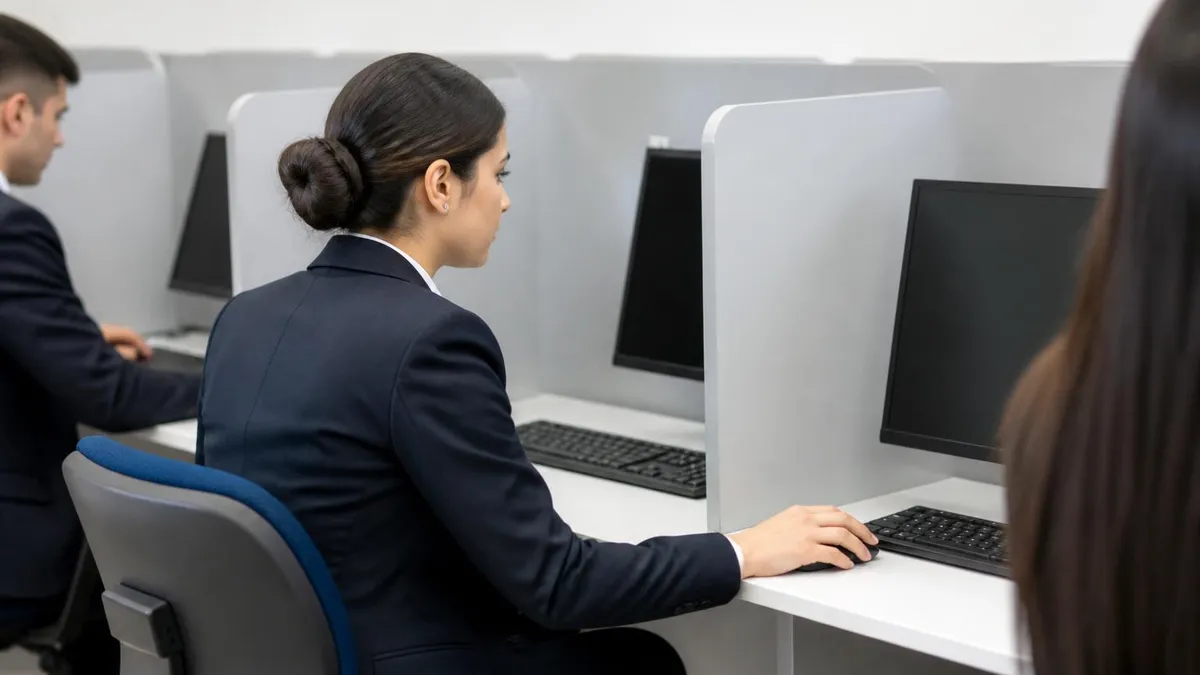
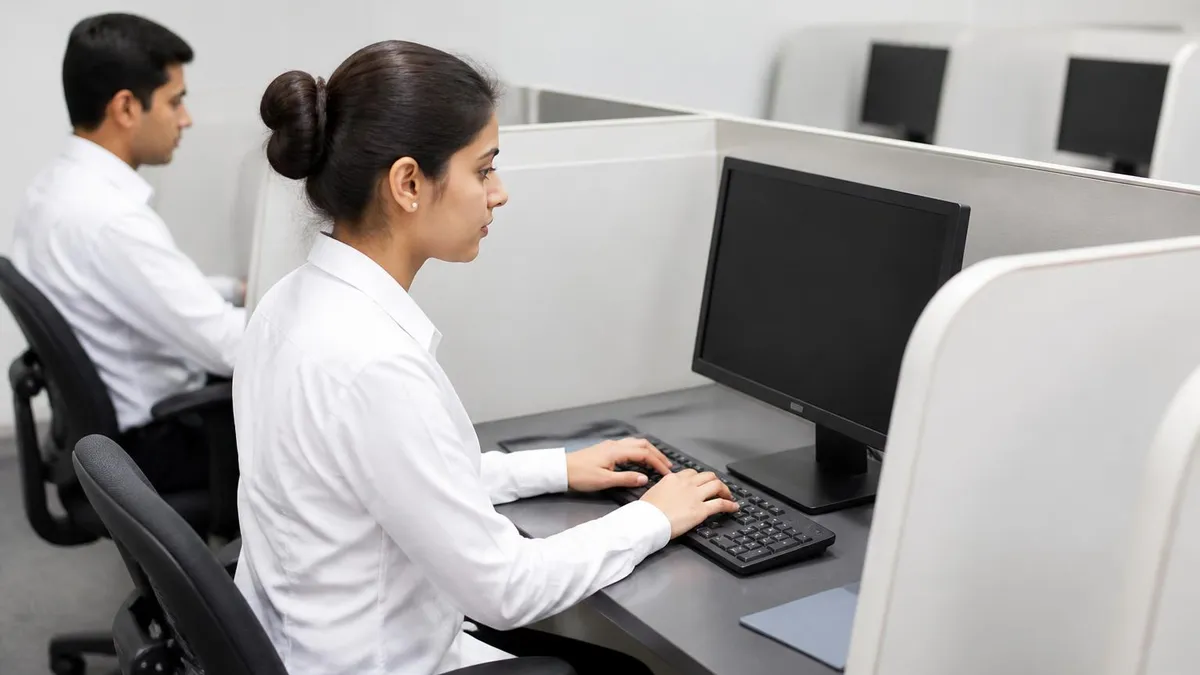
Each Prometric workstation is a small cubicle divider with a monitor, keyboard, mouse, and high-backed chair. Soundproof headphones are provided — most candidates wear them whether their exam plays audio or not, because they block out keyboard clicks from neighbors. The cubicle has overhead lighting plus a small task light at some centers, and a clock that you cannot see — exam time appears on screen instead.
You get scratch paper or a noteboard depending on sponsor rules. Personal calculators are banned. An on-screen calculator pops up in any section that allows one — the CPA exam, certain engineering exams, and most nursing assessments include a basic four-function calculator built into the test software. Erasers, mechanical pencils, and protractors stay in the locker.
5 Things Every Prometric Test Taker Needs
- Primary: Government photo (passport / license)
- Secondary: Signature card (credit / debit / employer)
- Name Match: Exact match to confirmation
- Where: Sponsor email
- Format: 16-digit code + center #
- Backup: Printed + on phone
- Buffer: 30 min before start
- Late Cutoff: 15–30 min varies
- If Late: Forfeit + full re-fee
- Sleep: 7–8 hours night before
- Food: Light protein + carbs
- Drink: Water, not caffeine-heavy
- Breathing: 4-7-8 before start
- Practice: Full mock under timer
- Anchor: 1 phrase for tough items
In-Center vs At-Home Prometric Testing
- +In-center: Controlled environment with no household interruptions
- +In-center: Professional workstation, ergonomic chair, soundproof headphones
- +In-center: Tech support on hand if hardware glitches
- +In-center: Wide exam availability — almost every Prometric sponsor allows in-center
- +In-center: Familiar testing rhythm for repeat candidates
- −At-home (ProProctor): Save commute, parking, and travel costs
- −At-home (ProProctor): Test from a quiet room you already know
- −At-home (ProProctor): Earlier and later time slots than most centers
- −At-home (ProProctor): Limited sponsor support — many exams still require in-center
- −At-home (ProProctor): Strict environment scan and stricter break rules
Accessibility and Accommodations
All Prometric centers in the United States are ADA compliant. Standard features include wheelchair-accessible entrances and restrooms, adjustable-height workstations, and accessible parking. If you need anything beyond standard physical access — extended time, additional breaks, a scribe, a screen reader, a sign language interpreter, large-print materials, separate testing room — you must apply through your exam sponsor, not Prometric.
The approval flow looks like this: you download the sponsor's accommodations request form, attach medical or educational documentation (typically within five years), and submit it weeks before your testing window. NBME, NASBA, NCSBN, and NCEES all have formal review committees. Approval can take four to eight weeks. Once granted, the sponsor sends an accommodations notice to Prometric, which attaches it to your appointment so the front desk knows what to set up on arrival.
Common accommodations include 1.5x or 2x time, ten-minute breaks between sections, a private testing room, a noise-reducing headset upgrade, ergonomic seating, and bringing approved medical items (insulin, EpiPen, glucose tablets) into the cubicle. If your exam includes audio, a hearing-impaired candidate can request a transcript reader. For vision support, ZoomText and JAWS screen readers are available at many centers.
At-Home Testing: ProProctor
ProProctor is Prometric's remote proctoring platform. It launched broadly during 2020 and now supports a growing list of sponsors. Eligible exams currently include several CompTIA certifications, certain nursing certifications, some real estate licenses, ECFMG English assessments, and selected international exams. Not eligible: USMLE Step exams, the CPA exam, and most engineering licensure exams — those still require in-center delivery.
System requirements are strict. You need a desktop or laptop running a supported version of Windows or macOS, a wired ethernet connection (no Wi-Fi for high-stakes exams), an external or built-in webcam with 360-degree environment scan capability, a microphone, and admin rights to install the ProProctor app. The test room must be private, well-lit, free of papers, electronics, and posters, with the door closed and no one else present. The proctor scans the room via your webcam, checks under the desk, and may ask you to roll up your sleeves.
Breaks are stricter at home. You stay seated unless your exam allows scheduled breaks. Eye movement away from the screen for more than a few seconds can trigger a flag. Drinking water, scratching your face, or shifting in your chair are fine — but turning your head or speaking aloud is not. For full prep, run a mock test under remote conditions using our prometric practice test pdf in a quiet room.
Test Day Timeline: From Wake-Up to Score
T-3 Hours
T-1 Hour
T-30 Min
T-15 Min
T-0 Start
Mid-Exam
End
Prometric vs Pearson VUE: Two Networks, Different Exams
Prometric and Pearson VUE are the two largest computer-based testing networks in the US. They are separate companies with their own centers, their own software, and their own rules. Some exams use only one. The CPA exam uses Prometric. The NCLEX uses Pearson VUE. The GRE and GMAT use Pearson VUE for most candidates. USMLE Step uses Prometric in the US. CompTIA certifications can use either depending on what you pick when you register.
The check-in flow is similar — two IDs, biometric capture, locker — but the rules around scratch paper, water, breaks, and re-entry differ slightly. Pearson VUE sometimes issues a laminated noteboard while Prometric is more likely to give physical scratch paper. Confusing the two can cost you. Always read the Candidate Bulletin from your specific exam sponsor and double-check whether your appointment is at a Prometric or Pearson VUE site.
The locator tools also differ. Prometric's tool sorts by distance and exam sponsor. Pearson VUE asks for the test program first. If your sponsor uses both, you may see a choice during scheduling — pick the network whose nearest center has earlier seats or hours that suit your schedule. Before locking in, run a full timed mock from our prometric practice test hub so you arrive trained for the format your sponsor delivers.
Late Policy and No-Show Rules
Most sponsors enforce a hard late cutoff between 15 and 30 minutes after the scheduled start. Show up later than that and you forfeit the exam and any fees paid. There is no waiver, no grace period for traffic, and no transfer to a later slot the same day. The CPA exam is particularly strict — late is late.
If you cancel in advance, the refund schedule depends entirely on the sponsor, not Prometric. Most allow free rescheduling up to 30 days out, charge $50–$100 between 5 and 30 days, and forfeit the full fee inside 5 days. Always reschedule through the sponsor portal, not by calling Prometric directly. For a step-by-step on changing dates, see the prometric reschedule walkthrough.
If Prometric closes your center for weather, power loss, or emergency, you will be contacted by phone or email — and the closure is also posted on prometric.com. Do not just show up. Sponsors reschedule you free of charge and waive the standard rebooking fee for center closures. Save the closure notice email — you may need it to prove the rebook was not your fault.
Prometric Questions and Answers
More Prometric Guides
About the Author
Attorney & Bar Exam Preparation Specialist
Yale Law SchoolJames R. Hargrove is a practicing attorney and legal educator with a Juris Doctor from Yale Law School and an LLM in Constitutional Law. With over a decade of experience coaching bar exam candidates across multiple jurisdictions, he specializes in MBE strategy, state-specific essay preparation, and multistate performance test techniques.